Daegu, South Korea / Oct 28, 2026
Embedded in the terrain between a public park, a lotus pond and the mountains beyond, the design of the art gallery creates a continuous spatial gradient, in which landscape, circulation and digital art unfold as a seamless experience.
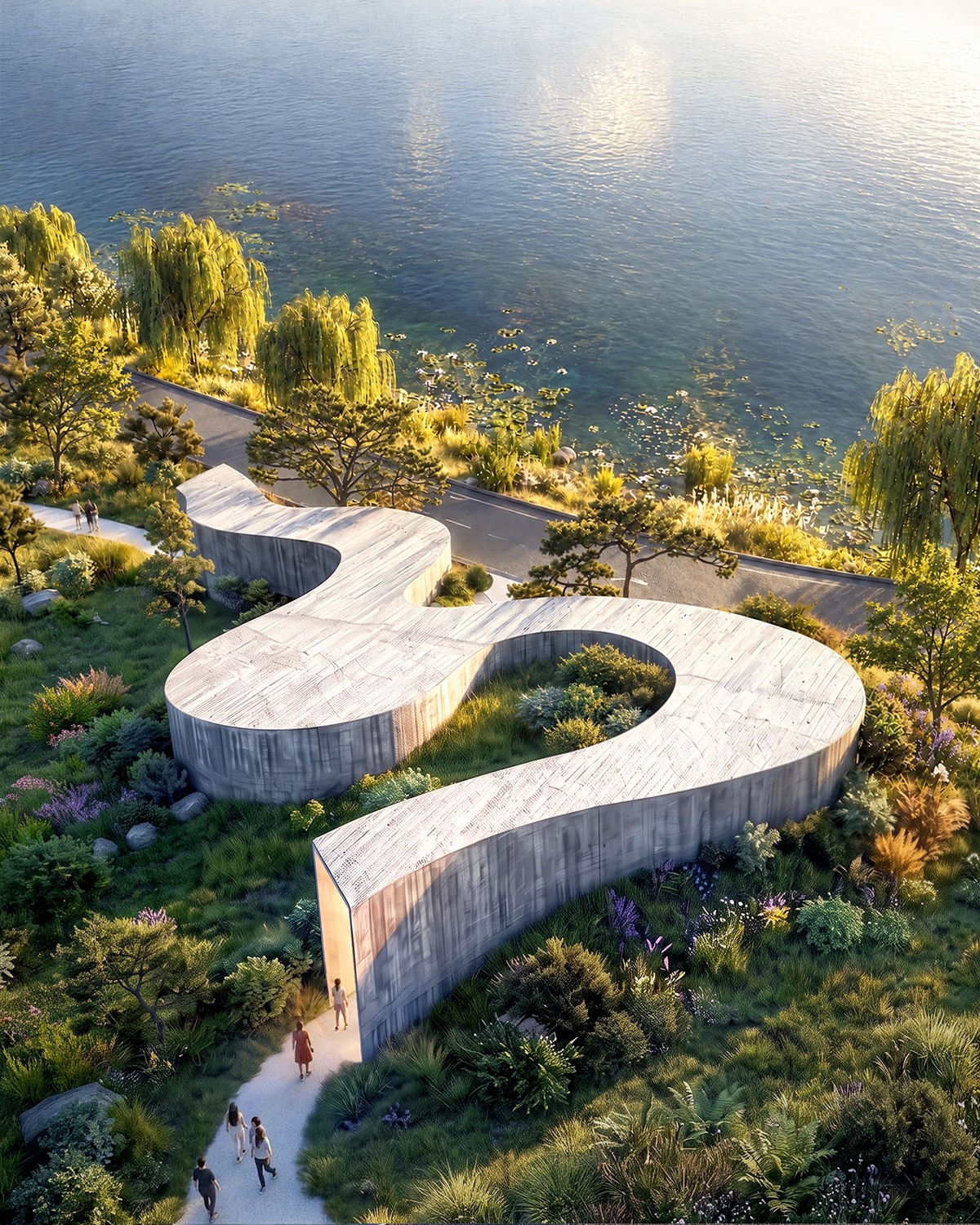
Büro Ole Scheeren has unveiled the design for Suseong Continuum, a digital media art gallery commissioned by the Suseong District Government for the Suseong International Biennale in Daegu, South Korea. The design is presented as part of the 2026 Biennale with the theme of “Living Ground”, and will be on view from 27 October to 22 November. The Suseong International Biennale invites architects, landscape architects and urban designers to realize permanent public works across the city, as part of a wider effort to build lasting cultural distinctiveness. Büro Ole Scheeren’s Suseong Continuum gallery is set to open for the next edition of the Biennale in 2028, with an exhibition program curated by ZKM | Center for Art and Media Karlsruhe.
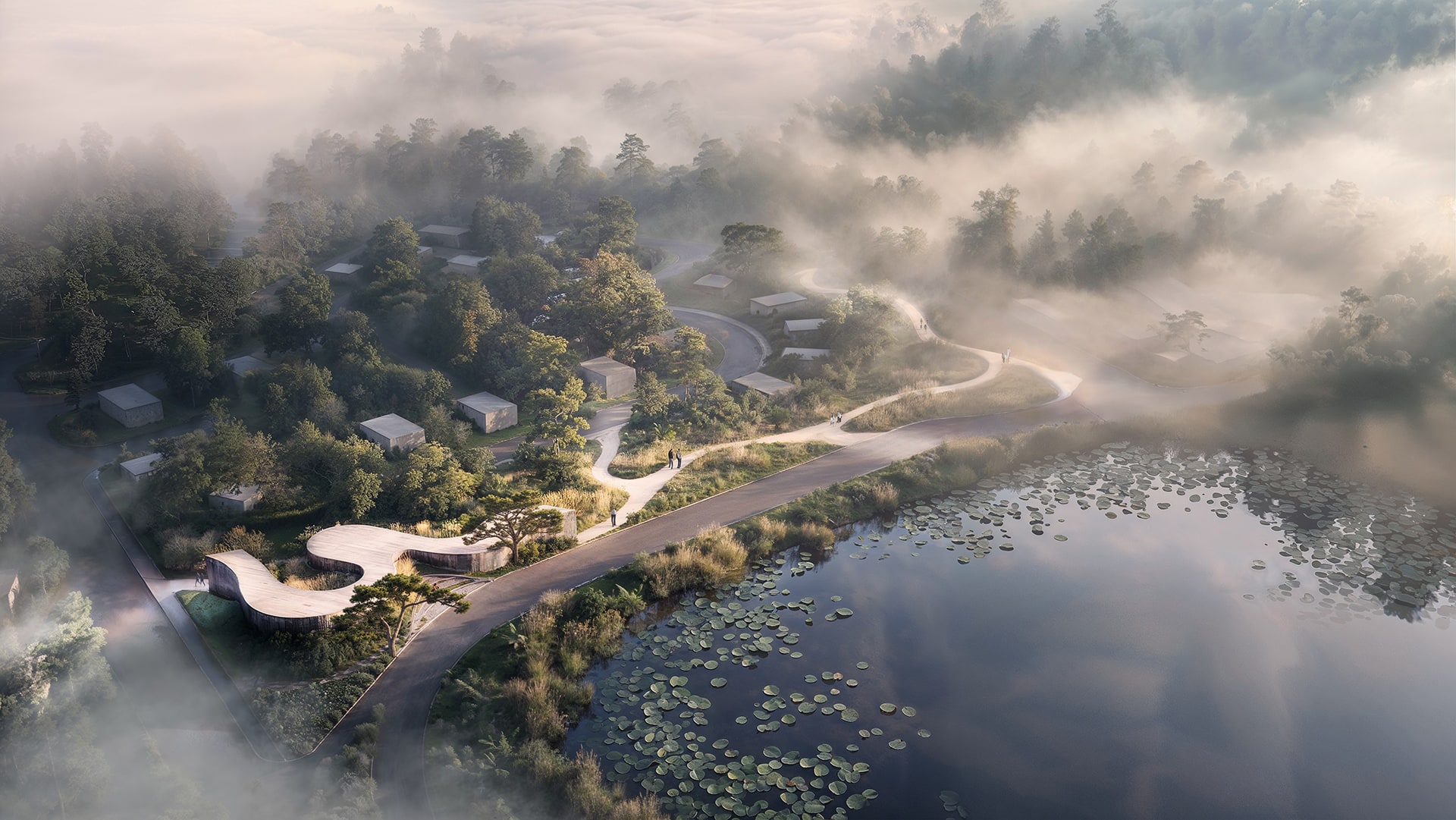
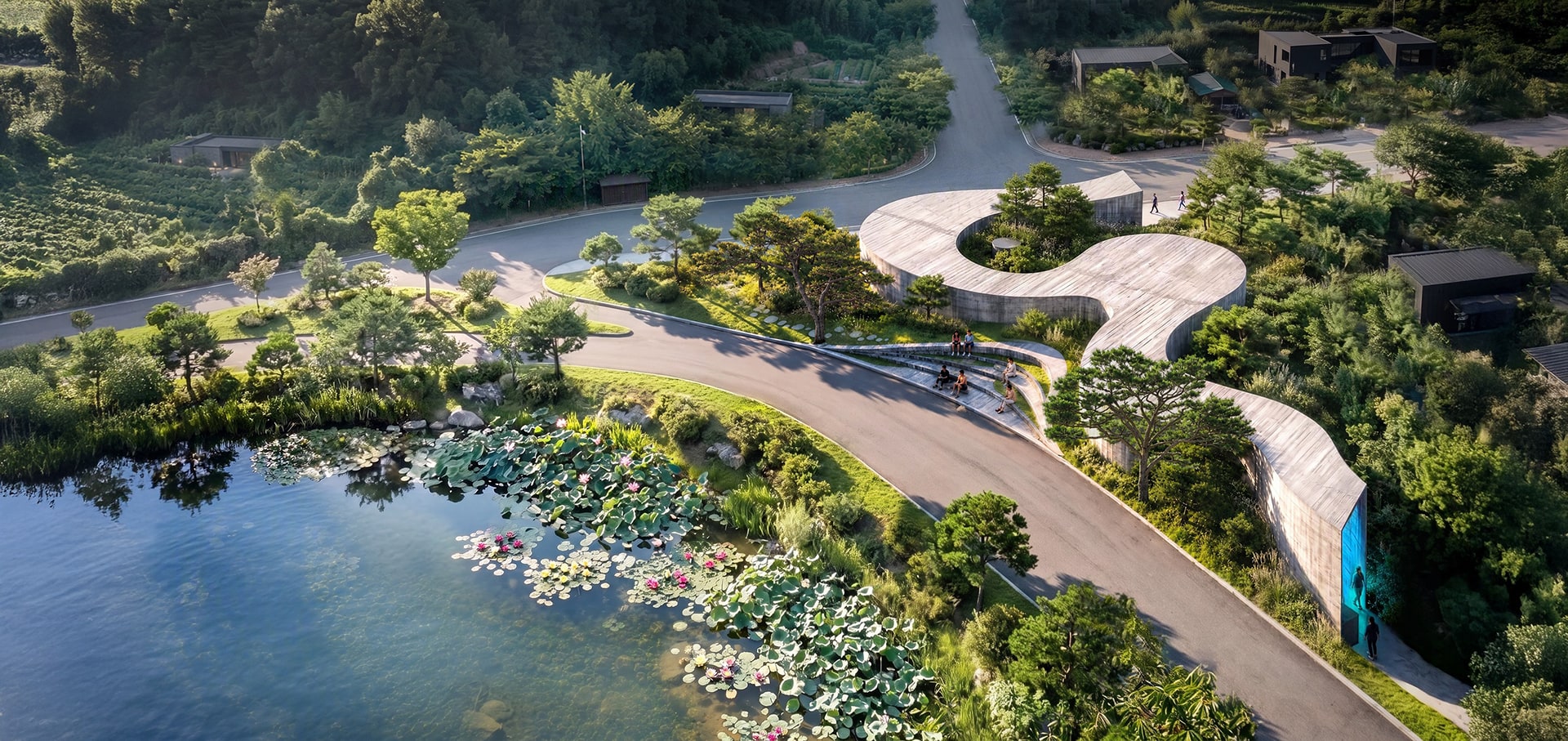
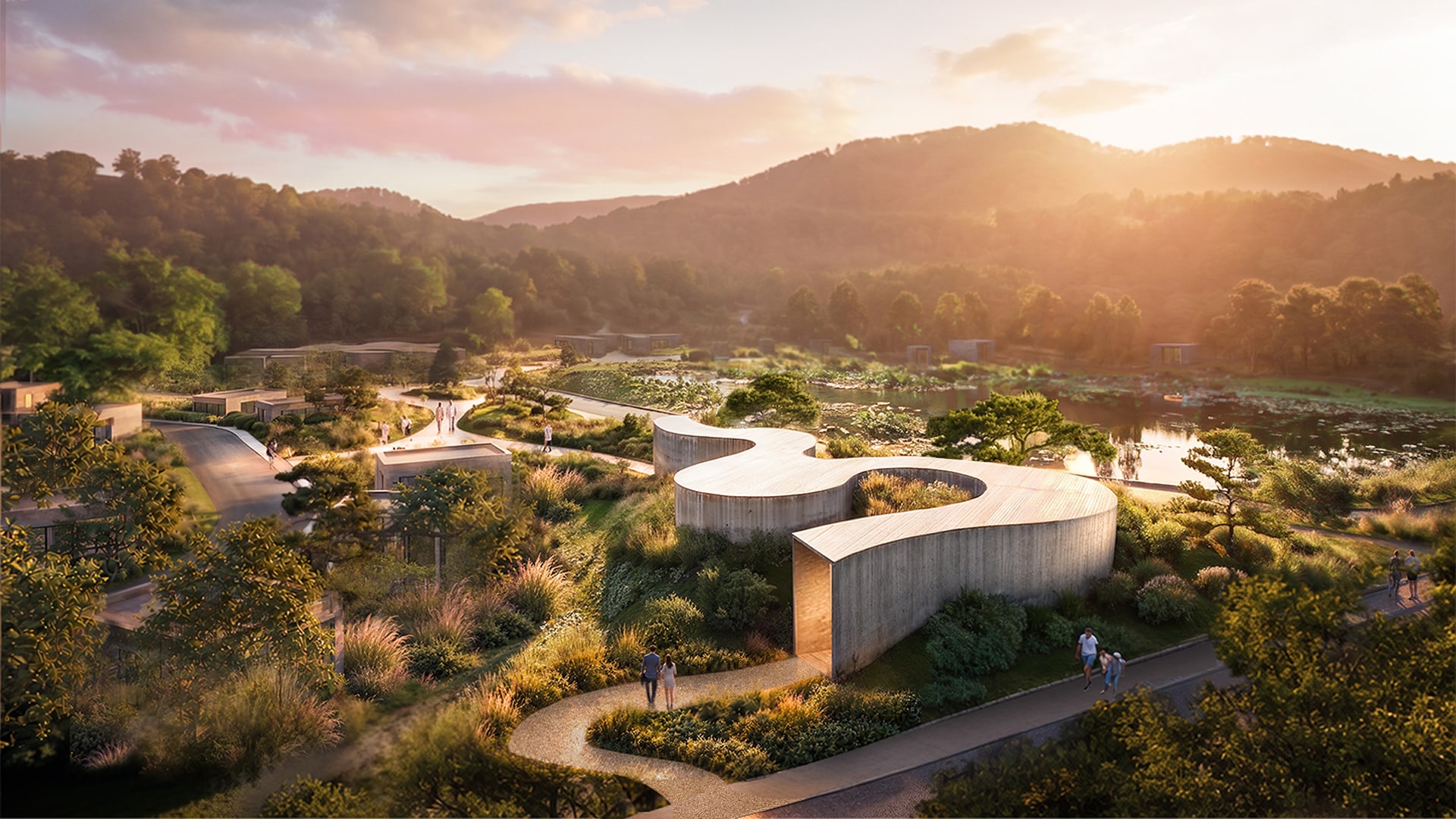
Set on a triangular site at Yeonhonae-ji between a public park, a lotus pond, a residential neighborhood and the mountains beyond, the gallery is conceived as a continuation of the landscape it sits within. A single, meandering path winds through the park and extrudes to form the volume of the gallery. Partially embedded in the terrain, it draws the pathways into an interior with no enclosed rooms and no doorways. Instead, landscape, circulation and exhibition become a continuous experience.
Beyond the Black Box
Digital art is still largely shown in spaces inherited from other media: the white cube and the black box of the modern gallery. Typically arranged in a sequential manner, these neutral, individual chambers isolate each work within distinct rooms of singular experiences. Yet, digital media has blurred the boundaries between the physical and the virtual, between reality and imagination. Digital experience is defined not by separate, self-contained environments, but by overlap, connection and continual transformation.
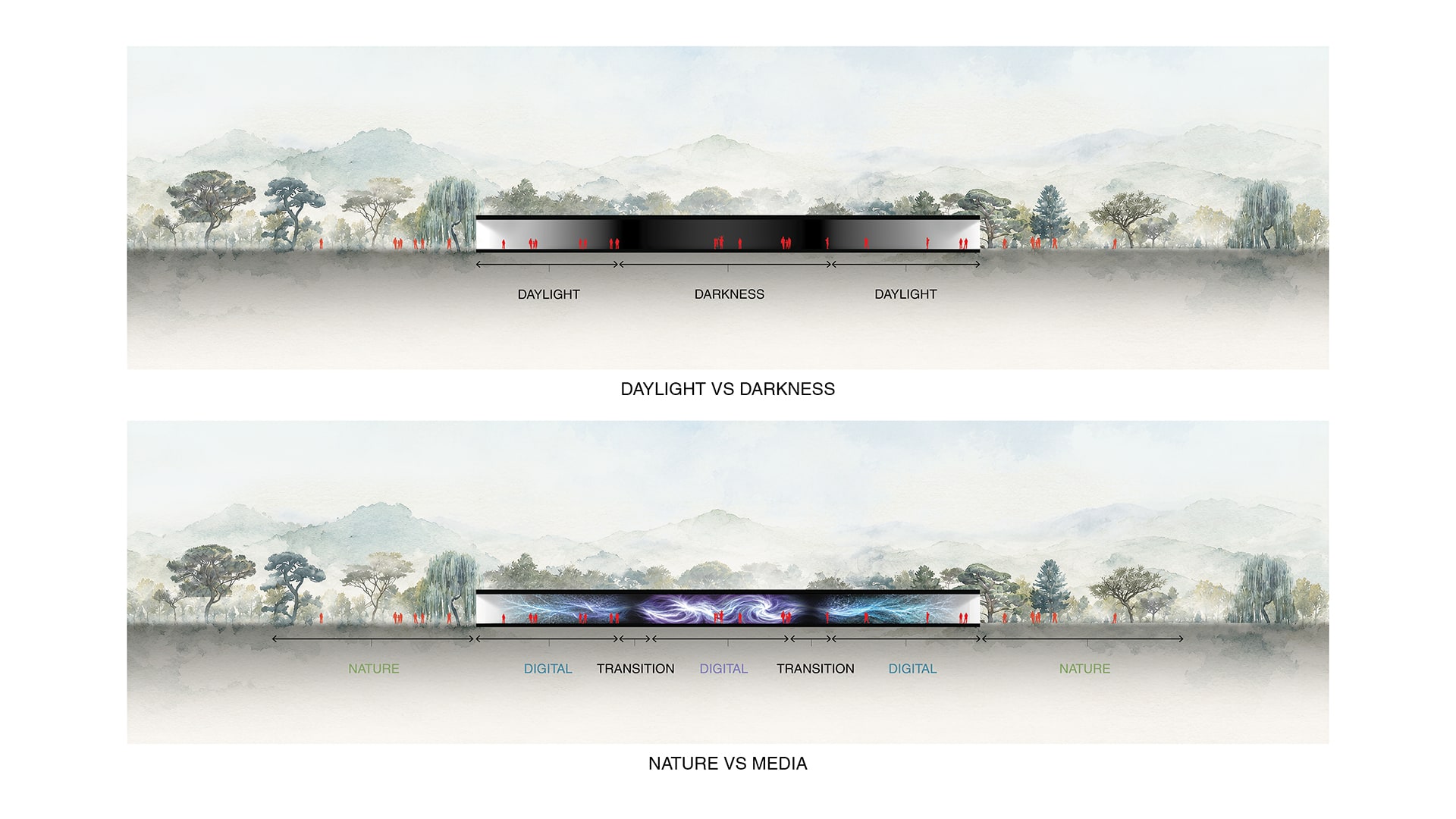
Suseong Continuum proposes a spatial model built on this logic. Instead of dividing the gallery into separate compartments, Ole Scheeren’s design establishes it as a continuous gradient field that generates a multiplicity of conditions by expanding, contracting and meandering. The question it asks is not which room an artwork belongs in, but where along the path of gradient realities it is best experienced.
“The substance of digital art is not rooted in the physical domain of distinct objects and isolated experiences… it exists in a world of overlaps and connections, where one condition potentially flows into the next. We wanted to build a gallery without traditional thresholds: a gradient of realities that morph into one another as you gradually move through the space,” says Ole Scheeren.
A Spatial Gradient
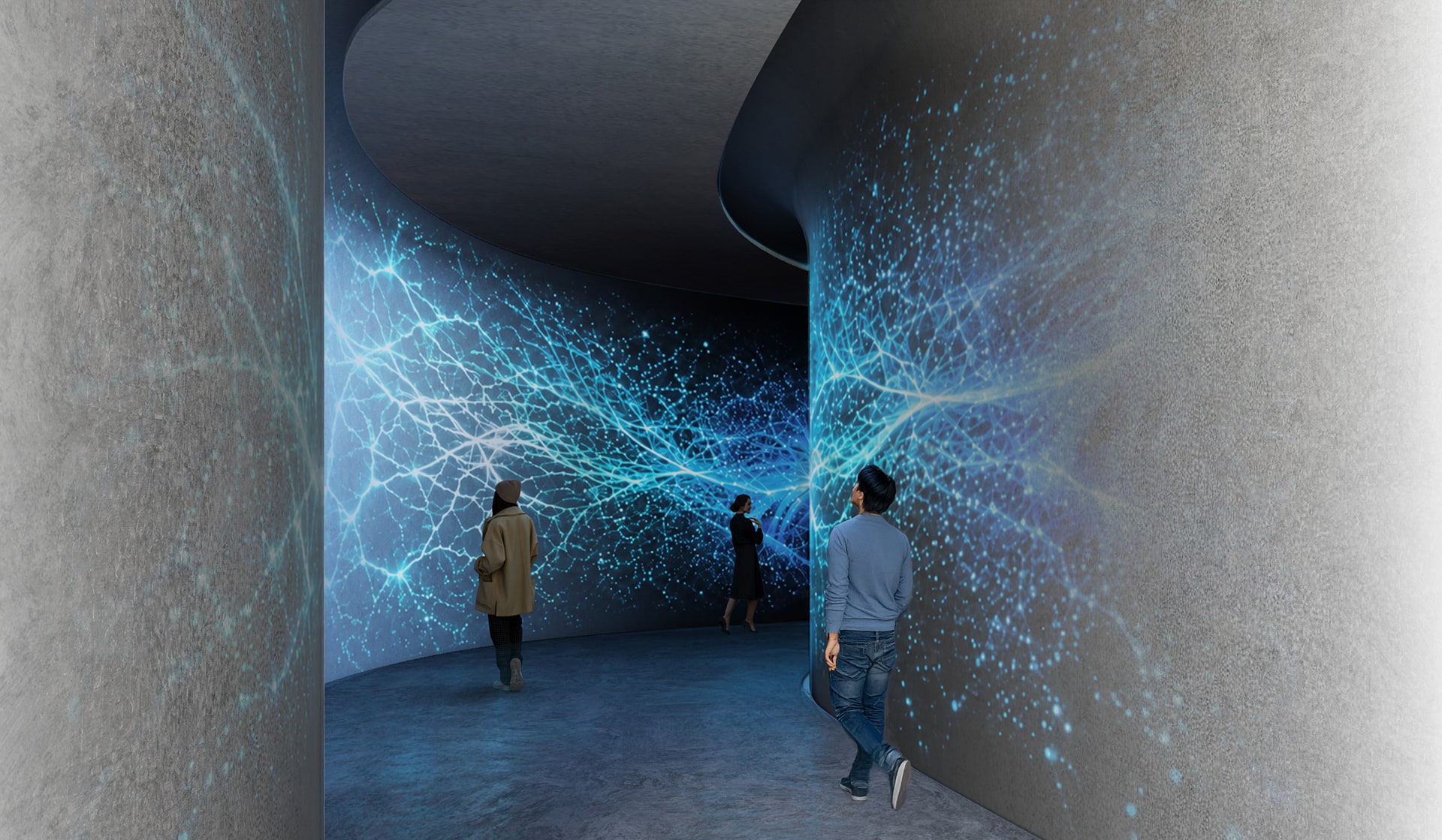
In a conventional gallery, change happens at the threshold: visitors leave one room, pass through a door and enter the next. In Suseong Continuum, change happens continuously. The interior unfolds as a spatial gradient in which light, sound, enclosure and immersion shift gradually along the visitor’s route. Curving walls widen into open spaces and tighten into passages; atmospheres transform rather than switch.
Along this route, the gallery moves through distinct states of contemplation, encounter and media experience, creating settings for different kinds of digital artworks without completely isolating them. Immersive zones can be enveloped entirely by digital media, while quieter areas can hold more restrained, relational installations.
From Landscape to Media
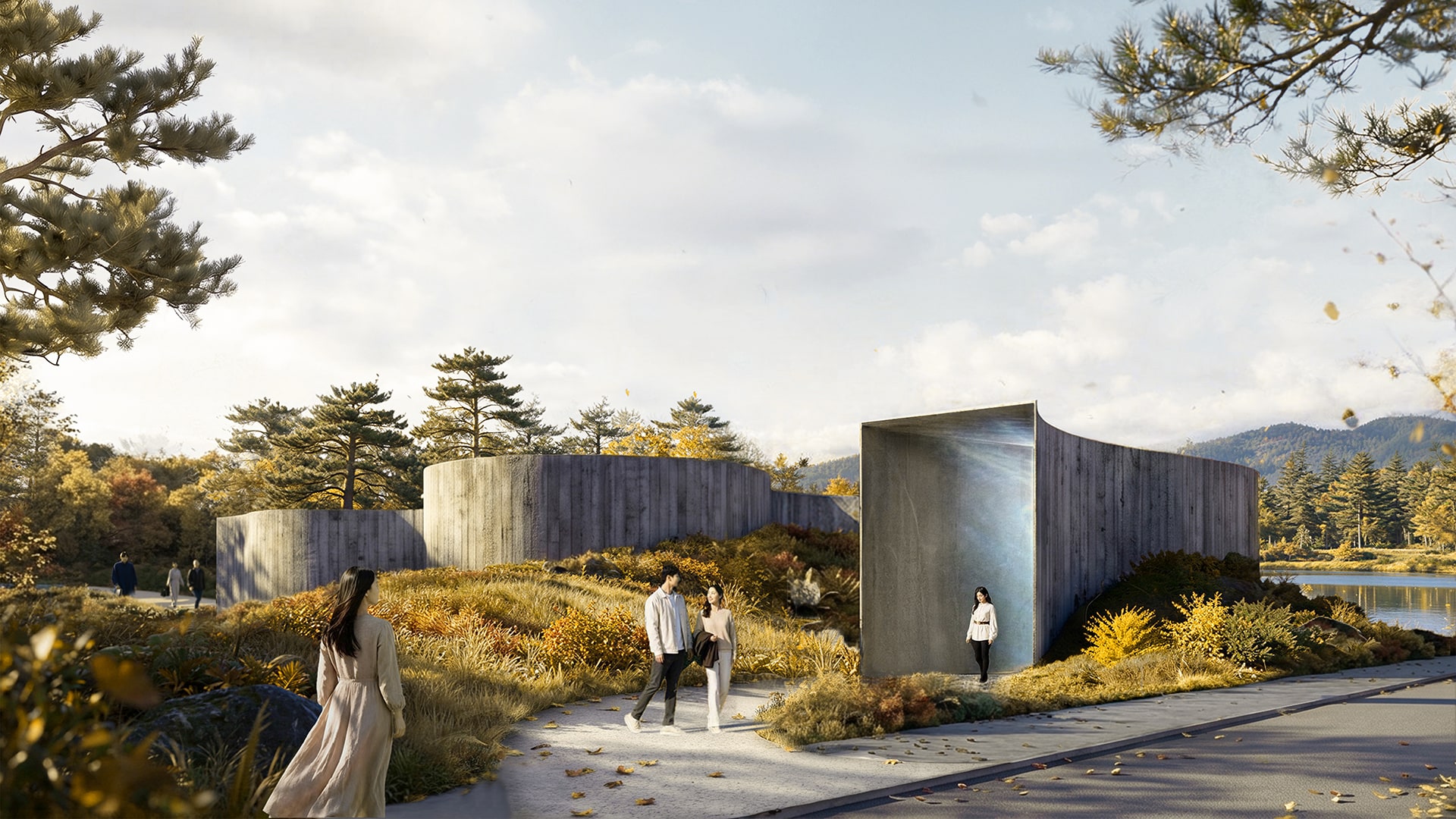
The gradient is also reflected in the gallery’s materiality. The visitor’s journey begins in the natural world of landscape and topography and moves into an immersive realm of digital abstraction, as the building’s surfaces make this transition tangible. Outside, the gallery is formed in rough concrete, imprinted by timber formwork made from pines sourced on site, trees with deep significance in Korean culture. Inside, this raw texture gradually dissolves into a smooth, white interior that is calibrated for digital projection. On the ground, gravel transitions to polished concrete. What begins as natural landscape gradually transforms into digital media.
“Technology is often seen as an opposite to nature. With Suseong Continuum we wanted to explore how we can create a way of extending the way we perceive the relationship between both domains – a journey that starts in the park and that seamlessly carries you into the digital realm. There is no single moment where one world ends and the other begins, it is a continuous transformation,” says Ole Scheeren.
A Public Ground
The gallery’s design explores the triangular geometry of the site by twisting and tapering the building toward the lotus pond and the pathways of the park. Its volume negotiates the different levels of the terrain and shifts in elevation to connect the park’s topography across the site.
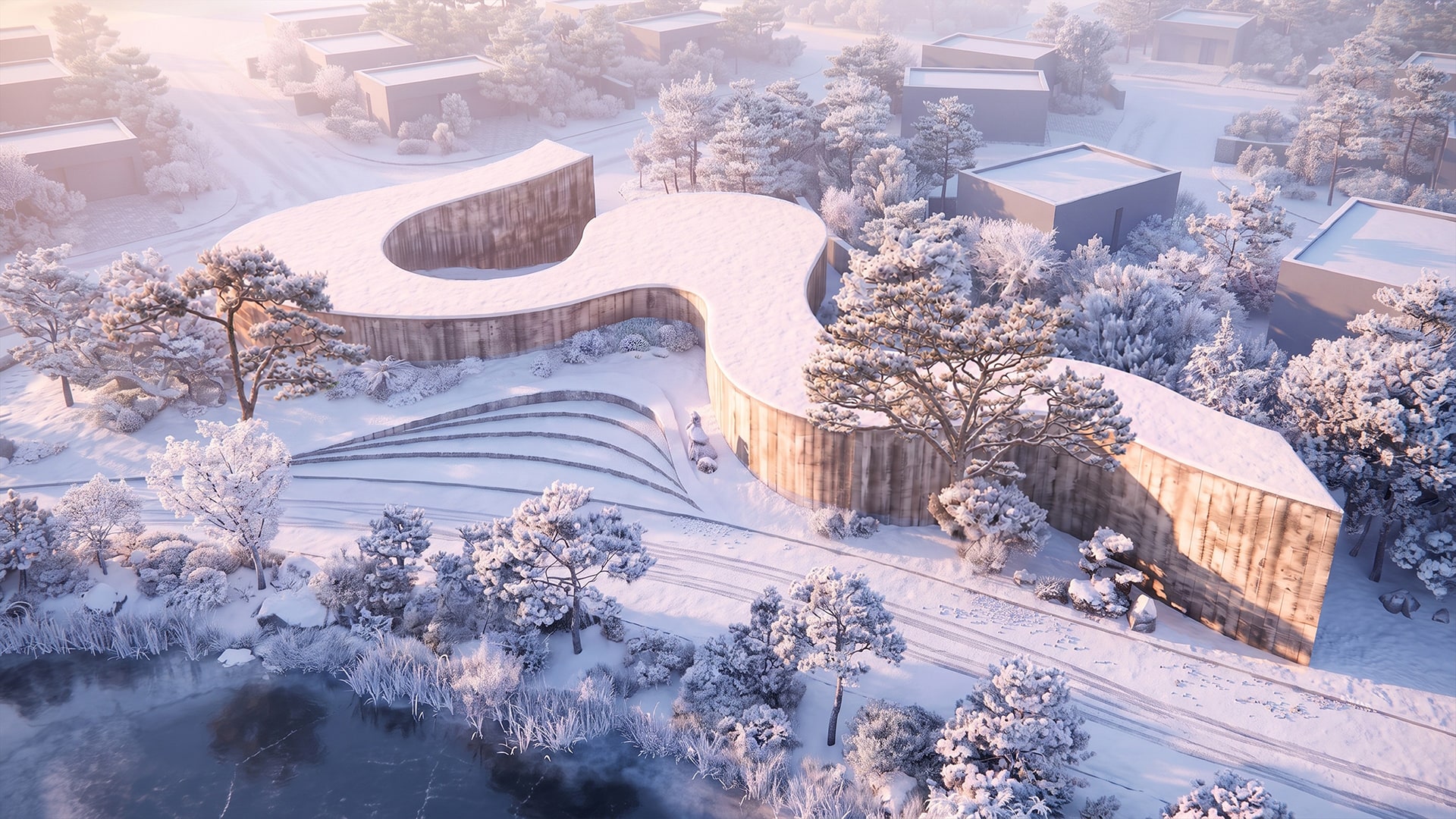
The semi-subterranean form performs an environmental function. Built in concrete for its durability and long-term flexibility, the gallery uses the surrounding earth as passive insulation, moderating heating and cooling demand through Daegu’s hot summers and cold winters.
Developed in close collaboration with ZKM | Center for Art and Media Karlsruhe to define its technical requirements, the gallery features walls and ceilings configured for immersive projection and seamless digital integration. A continuous, layered ceiling running the full length of the building conceals all lighting and technical infrastructure, allowing artists to reposition equipment anywhere along the route while keeping the exhibition spaces free of visible devices.
Suseong Continuum proposes an adaptable architecture in which physical landscape and digital space are not separate domains, but interconnected conditions that continuously shape one another. Embedded in its neighborhood and open to the public, it offers Daegu a different kind of cultural space for the art of the digital age.
With construction scheduled to begin in 2027, the gallery is set to complete in time for the Biennale’s next edition in 2028, when Suseong Continuum will open to the public as a permanent part of the city.
PRESS RELEASE: